Walter has a handful of shows coming up so be sure to catch him if he is near you!
Sunday, April 19, 2015


Sunday, March 15, 2015
Guitar Nuts - measurement confusion?

I have been asked where are the reference points for the guitar nut. Nut length is based on the guitar neck width. Hopefully, the following information can help eliminate some confusion about the nut length.

I have found that most novice players do not consider nut length measurement to be important while more advanced players have a specific preference which is based on their preference for finger picking or plectrum style picking. The player's picking style is the dominant factor in nut length choice.
Common neck width are as follows:
2.0" (51 mm) - Classical or nylon string guitars.
1 7/8" (48 mm) - Some steel string, finger style guitars.
1 13/16" (45 mm) - Steel string guitars.
1 3/4" (44 mm) - Most common length/width.
1 11/16" (43 mm) - Many electric guitars use this length/width.
1 5/8 (41 mm) - Smaller electric guitar similar to Fender® Duo-Sonic®.
This image will give you a good idea for comparison.

One important note about measurement is the fact the US standard measurement is used. I prefer the metric system but it seems that the guitar world isn't about to change this anytime soon so I have listed 3 measurement reference in my details; inch/decimals, inch (fractions), and metric equivalence. Save your time and don't send me mail telling me that the US Standard measurement system sucks. I AGREE!
This is a Telecaster nut with a 9.5 º radius

According to the calipers: this neck is 1.6205" or 41.16mm in length
(NOTE: This is not a Fender Telecaster - It's a BILL NASH TELECASTER)

Usually Telecaster nut length is 1 11/16 inch or 43.0mm in length. Nevertheless, the critical points for dimensions of nut length will be end to end of the current nut on the guitar or the width of the neck if there isn't a nut available to measure.
Below are random examples of guitar nuts being measured
This is a Taylor 514 with a length of 1.75" or 44.66mm - measured end to end.
This would round up to what is called a 1 3/4 nut

Below is a Fender Stratocaster 50th anniversary measured at 1.6915 " or 42.96mm.
This would round up to what is called a 1 11/16 nut.

Below is a Paul Reed Smith Custom 24 nut measurement.
This nut measured 1.6935" or 43.0 mm. This is also a 1 11/16 inch neck

If you need to replace your nut and you are buying one online; often you will be asked to provide the E to E measurement. Below is an example of a Taylor 514ce E to E (Center of the Low E to Center of the High C) measurement being recorded.

String Spacing: I use a tool that I purchased from Stewart MacDonald to determine and replicate string spacing. Below are some images of the tool in use.

More of the same .....
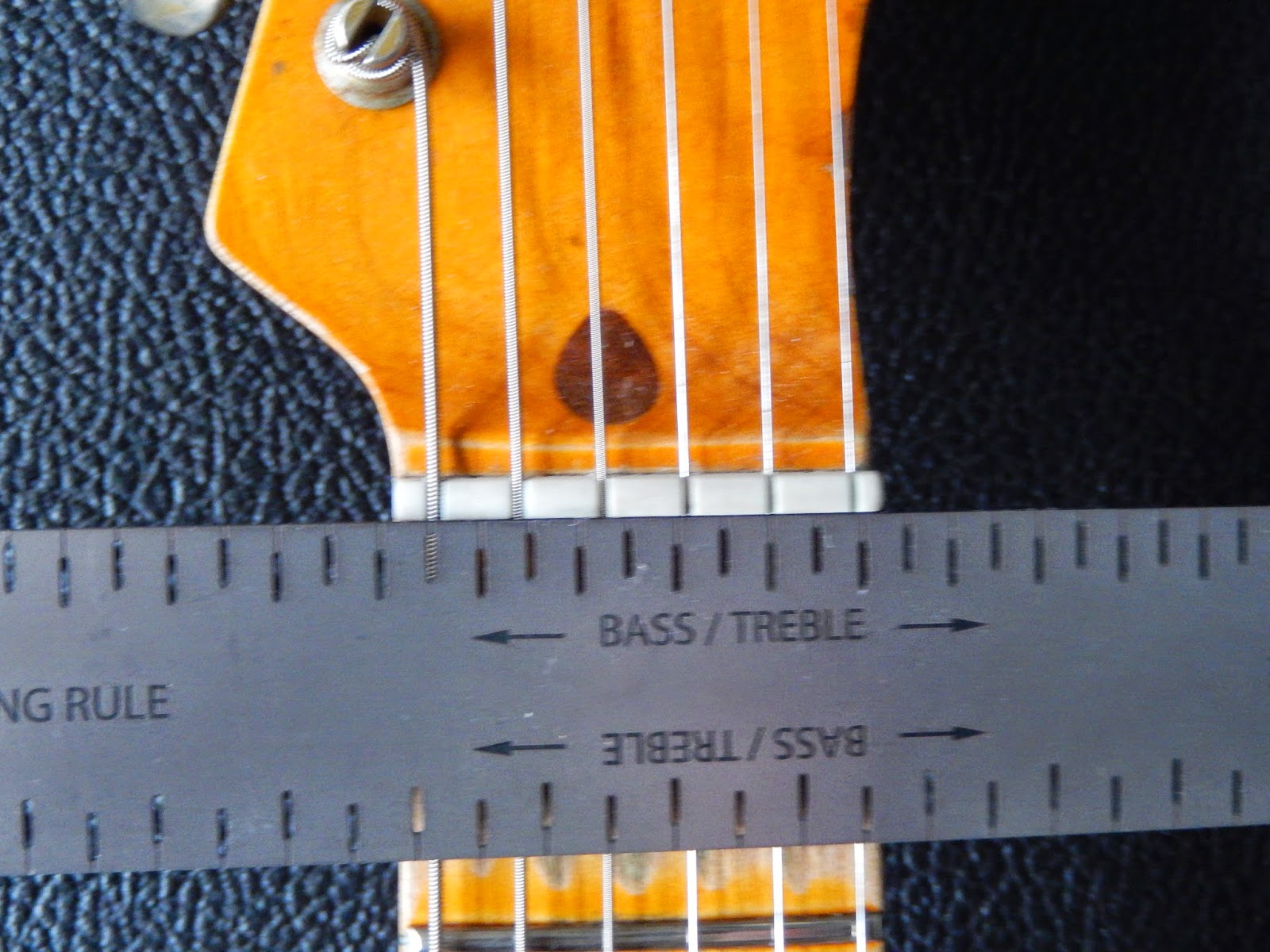
The tool is about 12" or 304mm measured length


In summary, nut length is measured end to end of the nut. If you are making a nut from stock it is always better to start out with a little more than you need then file the blank down to match the neck width. Measure twice and cut once! For further information I recommend Frank Fords site Frets.com.
Other valuable Links:
A closer look at Nuts (LOL!)
Frank Ford is one of the owners and Luthiers at Gryphon Stringed Instruments.
Friday, November 28, 2014
Kelly Zullo - Talented Artist!
Kelly is a talented artist that lays fat grooves on her guitar along with thoughtful lyrics. See for yourself. Her style is unique and very captivating.
Being a left coaster I'd love to see her at Hardly Strictly Blue Grass Festival and/or Outside lands or anywhere in the SF bay area!
This will send you back to the woodshed. Stay at home and practice or just stay at home!
Check her out & buy her music.
www.kellyzullo.com
Being a left coaster I'd love to see her at Hardly Strictly Blue Grass Festival and/or Outside lands or anywhere in the SF bay area!
This will send you back to the woodshed. Stay at home and practice or just stay at home!
Check her out & buy her music.
www.kellyzullo.com
Sunday, October 12, 2014
Born in Chicago the Documentary
Unfortunately this documentary didn't attain the level of support needed to bring this project to completion.
Born in Chicago the Documentary
It is sad to see that this project didn't make it to the general public.
Gibson G-Force and Min-Etune

I have already carped about this system in the past. I think that change and innovation is good but now it's being rammed down our throat. If you want a Gibson Les Paul, no matter which model, you will get the new improved Min-E tune which is now called G Force. If you don't want it, then pony up for a reissue Les Paul or a 120 model where the new system has yet to be employed. I am mostly disappointed in the entry & intermediate level instrument line where there is obvious lack of choice between traditional friction tuners as opposed to the electronic auto tune. I don't want to get emotional about this issue because ultimately the most important thing is that the new players receive tools that will enhance their creative ability. I could carp about relying on electricity but SMH (smack my head), we are talking about ELECTRIC GUITARS so what is the point? I guess I am holding on to the the lack of "Choice" as my bitching point. I think everybody should know how to manually tune their guitar. However, there is some very good arguments for installing the electronic tuning that Gibson calls G FORCE.

What is convenient about the tuning system is that the user can change tuning in seconds. This will expand the range of creativity for musicians. The users can install custom tuning and teach the G FORCE to remember the tuning. The unit is rechargeable thus minimizing the need to buy batteries. Do you recall when guitar effects and/or foot pedals where dismissed as needless props? Conversely, now we see that the effect/foot-pedal market turned into a cottage industry where people are frothing at the mouth over the latest iteration of FUZZ pedals. With the foot-pedal mania somewhat satiated, I can see that the auto tuners could be seen as utilitarian as any famous effect pedal. One must admit that changing from standard tuning to drop D tuning in merely seconds is very enticing.
Like it or not, Gibson is trying to be your guitar company. It's a tough job satisfying the long devoted legions while creating innovations for tomorrows players.

Update 6/5/21
A lot has happened to Gibson since I first posted this on my blog. Since 2014, I have seen countless guitars retrofitted with standard tuners. Another reason to remove the Mini-E tuners is that their added mass makes a vulnerable instrument even more susceptible to headstock fracture. Lastly, most consumer electronic have a bathtub curve for failure while mechanical tuners could endure 50 years or longer with standard use. This is a solution for a problem that never existed.Monday, October 6, 2014
Rare Film of Little Stevie Ray Vaughan before he was famous!
If Stevie were alive today he would be 60 years old as of October 3rd.
Enjoy!

Thursday, October 2, 2014
Malcolm Young is not well
The other shoe drops as the news spreads that Malcolm Young is suffering from dementia and has been replaced in the AC/DC lineup. Since the AC/DC is a family run organization the effect of Malcolm's health must have been devastating especially in a business where the credo is "The show must go on." Let's all wish Malcolm and his family the best! Let's all welcome Steve Young as he fills in for Malcolm. Rock and roll ain't noise pollution!